

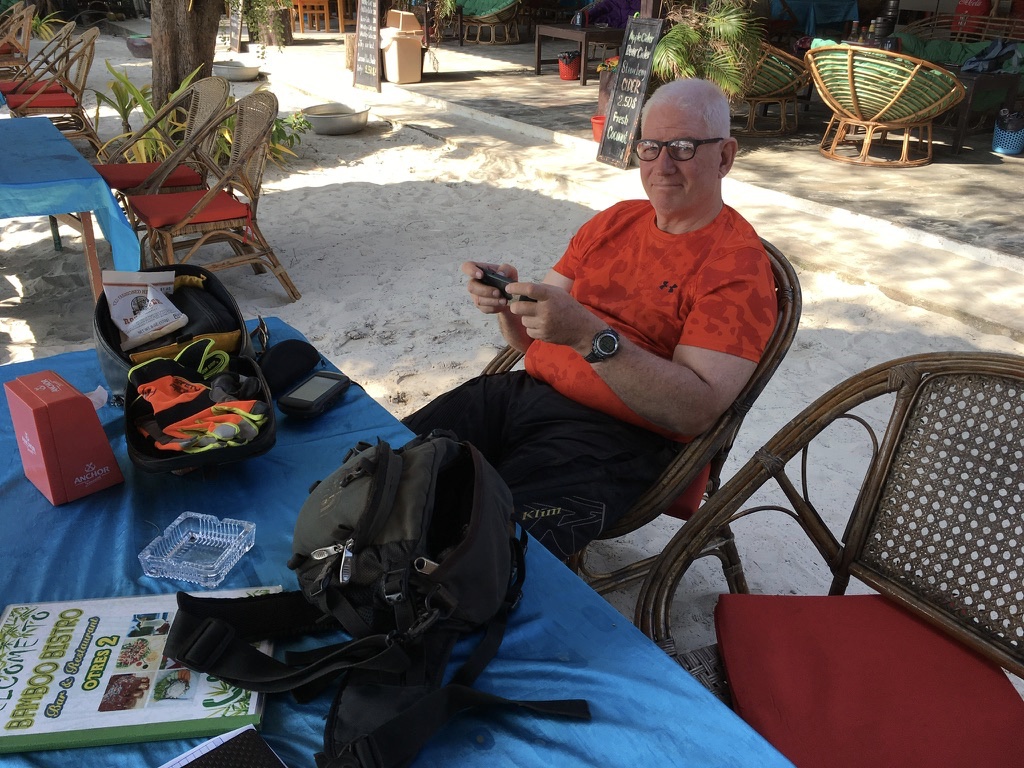
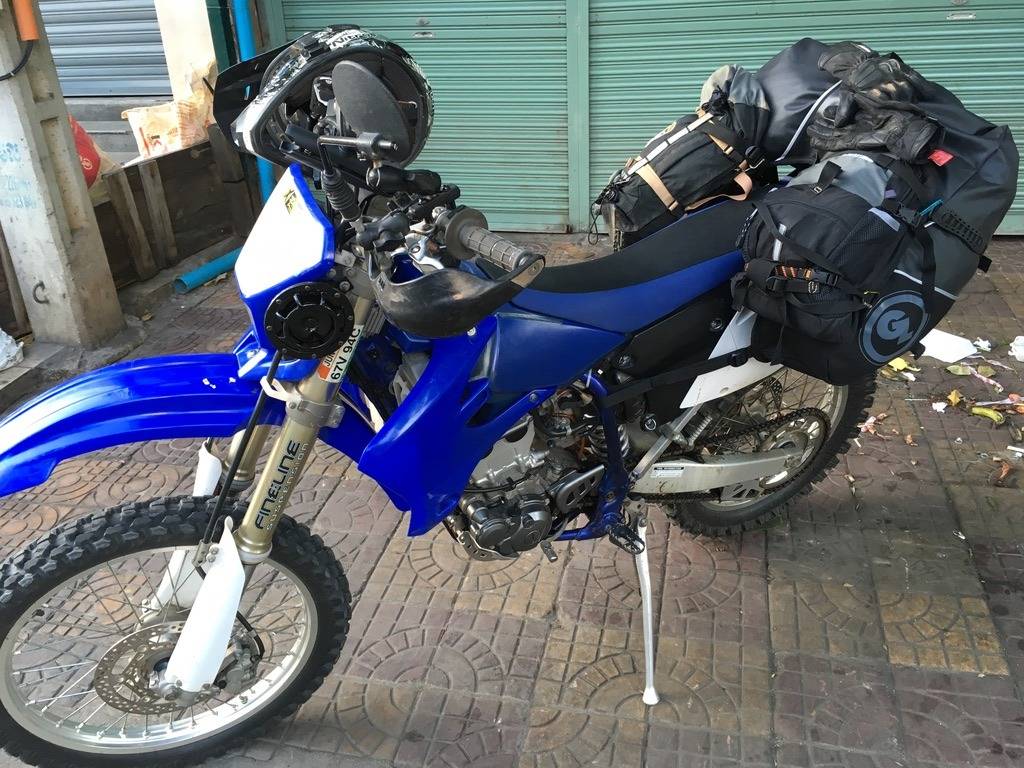
Dave Everitt and myself met at Sang’s shop at 7 am on Sunday morning the 12th of February, 2017 to travel south through the roads closest to the Tonle Bassac and on down to Takaeo town. We then traveled down through the salt flats to Kep and then on to Kampot town.
We contacted Dale Jones to see if he was available to meet and scheduled an appointment for Monday morning.
We spent over two hours talking to Dale about how things had been going in the area around Kampot. His wife had not been well and a lot of their effort, recently, had been just to get settled and to get her comfortable. They were also home-schooling the two kids left at home and that was going better than it had been previously.
I had just been to Victor’s wedding the week before and folks were talking about at least two big networks of churches up in an area just north of Kampot city (Chuuk?) and so I asked Dale what he knew about those. He said that those groups had been started by Food for the Hungry organization. There were a lot of groups started by that initiative and they were based largely on food distributions. He stated that the groups were not as vibrant as was reported to me, but that there would be strong attendance if something were being offered for free distribution. If you show up to a group unannounced and/or there was no rice distribution then the number of folks participating in the group would drop from 125 to 5.
He also stated that he doesn’t really count kids in those numbers. Parents will allow children to go to those services just to get them out of the house, but once they reached teenaged years and older, those youth were discouraged from attending services. Very rarely would those kids stick with following Christ through the teenage years if their parents were not active participants in the church.
It is difficult to engage these folks in kingdom work that have an expectation of food/support/gifts and Dale is desiring to start over with new people rather than trying to re-train the old people.
Dale also shared his experience in entering a new village or family, it is really key to find the decision maker in that group. It could be a woman or a man, but once you find that person and they allow you access to their family (even if they don’t believe themselves) then things will go better. The other people under their influence feel like they have ‘permission’ to explore following Jesus if the gatekeeper to the community/family unit allows it. It’s even better when that key individual believes and people will be very likely to follow as a group. (like Cornelius and the Philippian jailer)
He also encouraged coaching from behind and never taking a leadership role. It is so hard to back out of that once it gets started so it is much better to never let it get started. He also started having services at his house, which he later regretted, because if he were not there the group would not meet. He gave several examples of mistakes he had made along the way and now some of those groups were not even meeting anymore. I was very thankful for his honesty, as it can be very uncomfortable to be vulnerable like that but very helpful to hear those observations.
He has also come across some people that identify themselves as Khmer Muslims in contrast to Cham people. I can’t remember now the distinction that he made between the Cham and Khmer Muslims, but he said there were distinct differences.
Leaving Kampot, we traveled along the coast and then north to National Hwy 4 an on into Sihanoukville. We contacted Jeff Hogue and he was planning to travel back to Koh Kong that night after doing medical in BKK for a couple of weeks, so we made an appointment to meet him the next day.
We rolled into Koh Kong at about 4 pm on Tuesday and met up with Jeff. Since they were just returning from BKK after unexpectantly being gone for a month, Victoria Cox had made chicken pot pie for supper and brought it over. The entire Cox family came over as well and we were able to visit with them.
Chris is in the process of developing tracts to hand out to Muslims with a few key questions on them. The design is about the size of a business card so it will be convenient to hand out. The questions are designed to get people thinking and questioning their beliefs. He is also working on a Facebook page called Kiet Yung /Our Town https://www.facebook.com/ourcountryourstory/ . On this page people would have their picture there and they would be able to tell their story.
Jeff told us that Chris was trying to connect with the leader of the Independent Baptist group that was there in Koh Kong. There were Independent Bapt M’s that were there for many years. I believe their names were Harold and Mary and they were very protective of the people with which they worked. They really did not want any help or input for their programs and they really isolated their folks away from any other believers. They were very restrictive in what songs could be sung (translations from English hymns/melodies only and no Khmer tunes allowed) and exclusive in their teachings. Someone had tried to talk to Harold at one point about the unhealthy system of clients that he and his wife were patronizing, but he did not see it that way and dismissed those observations. Harold and Mary left Cambodia to retire and go back to the US in the summer/fall of 2016. When they did, the people that had participated in their faith community no longer gathered to meet. There could be many reasons for this, but Jeff, who knows some of these folks, thinks that when the support of the M’s left, then the interest of the people waned. Harold and Mary are coming back this summer to see if they can kickstart things and get folks engaged again.
When Dave asked Jeff about the Korean influence around Koh Kong, Jeff’s face fell and he took a deep sigh. While they had gone Stateside for a year, an older Korean missionary came to the area and found people worshipping at ‘The Beach Church’. He took over the leadership of that group and felt that they could not do much on their own. He did not speak any Khmer, so there were several cultural issues and miscommunications that created stresses in that group. When Jeff returned to Koh Kong, Jeff and the Korean missionary crossed paths and the Korean missionary told Jeff how he found a group of people worshipping on the beach that needed leadership and had been abandoned by those that had previously helped them. Jeff then told the Korean missionary that he was the one that had started that group and that he was still around. A tension lingered and even escalated as time went on, and Jeff did his best to try to vent the building pressure but was not successful. Finally, the Korean missionary left but his intentions of returning or future influence in that area are not known.
We wound up spending the day with Jeff on Wednesday and asked what was on his schedule of things to do. He mentioned he had several people that he wanted to catch up with to see how they were doing since they had been away as a family for over a month with medical issues. One young woman in particular had been acting strangely and now was having difficulty walking and talking clearly. We took a ferry over to the island and met with this young woman and her family. Lena had trouble walking on her own and needed assistance. She could talk better that day than she could in the past, but her answers to our questions were not consistent with the conversation and would trail off to different subjects. She acted sick to her stomach and kept gagging like she was about to throw up. We gave her water to clear her throat but then she would attempt to throw the water out of the bottle and onto us. We asked if she wanted to be free from this spiritual persecution, but she would not respond clearly. We felt like a spirit was possessing her or attacking her physically so we prayed that God would intervene and rid her of the presence of that spirit. She was not delivered from that persecution while we were there and she in fact got worse in the following days. I am hoping to hear of an update in the near future to check on her condition.
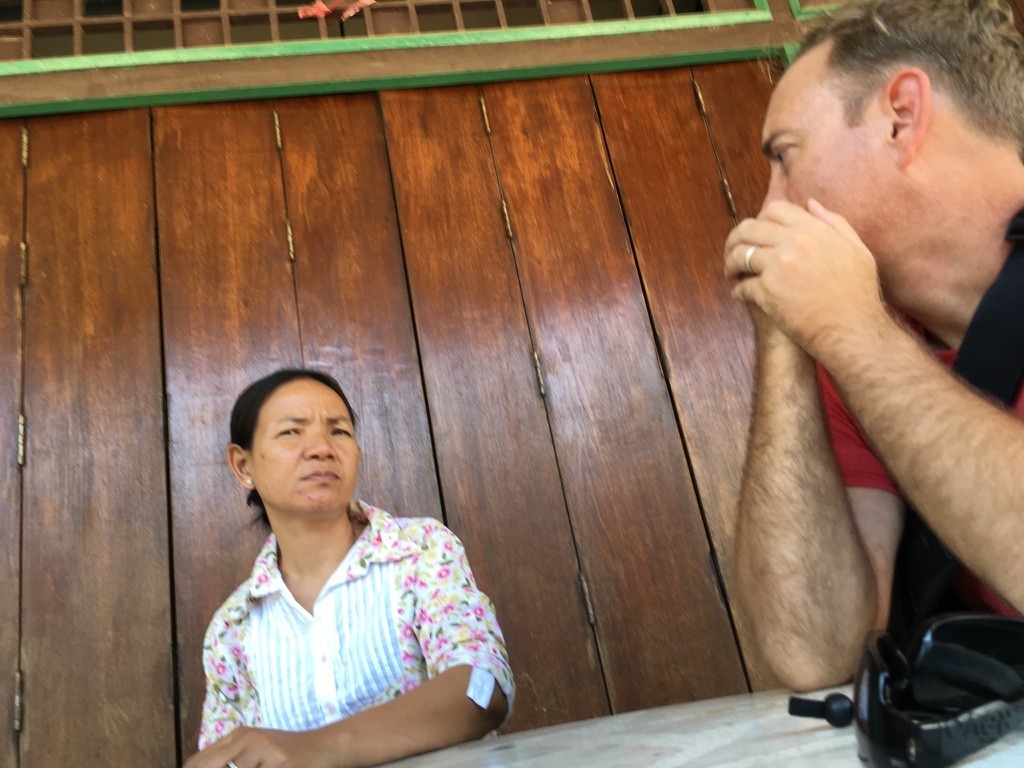
There were also some other folks in that fellowship that were distraught. One was a leader there and Jeff described him as acting bi-polar. Some days he would just hide in a dark recess of his home and not come out to visit even with encouragement to do so. On other days he would be full of joy and very energetic. Sometimes it is difficult to discern between mental illness and spiritual warfare/oppression and so we continue to pray for those in that group. Jeff also mentioned that using Discovery Bible Studies as a way to engage people in discussions was effective in encouraging participation and group learning. Some other conversations have come up recently with other folks that I’ll include in this report fitting with the theme of assessing the effectiveness of ministry activities in Cambodia and our world as a whole. Recently, I had been talking to a friend of mine about visiting people and sharing Good News by way of multiple visits. (See separate - 4 visits - document) This has been working well with many folks and has created a great community where they meet together and pray almost every night. Dave told a story about his friend that is a leader out in Busra (Truey?), just north of Mondulkiri. The leader out there said that things have changed a lot over the years out in his region. The whole group used to get together and walk to a destination that was about 30 km away. It took several days to complete the journey, but they really enjoyed the comradery as they traveled and they became a close-knit group. As time went on, some folks were able to get bicycles and then motos. This would exclude those that did not have their own transportation and so they just would not go. Then people got busier with their jobs and they stop going on these short ‘mission trips’ altogether. Recently, this same leader got a car. People had started calling on him for all their transportation needs. He was struggling with what to do with this increase in demand for the use of his car and how was he going to maintain it through all the wear and tear of heavy usage not to mention the time commitment on his part to drive the vehicle. People have paid for gas, but he is not getting any compensation for maintenance and repairs and he is wondering how long he will be able to maintain this activity financially and with his time commitment. He knows he needs some help with the driving responsibilities and he is still processing on how to respond to all the requests for transportation help. Not too long ago, a contingent of Korean folks approached this same leader and asked if there were folks in his area that desired a building for their fellowship. He reflected on the changes that happened in his own church when a building was built. He remembered that in the old days when people would worship in someone’s home and they would hang out for a long time to eat and visit. When a church building was provided for them, they would attend the service and then everyone would then scatter and go home, which greatly limited their fellowshipping. Counting the costs of closeness in the church community and the burden of maintaining a building, this leader asked the Korean group not to build any more churches in their region. It is a difficult balance to know when our helping is really patronizing and weakening those we serve. God has blessed us in many ways and commands us to help, (verses below) but I really need guidance/help to know how to do that and not cripple those I’m engaging. 1 John 3:16-18: 16 This is how we know what love is: Jesus Christ laid down his life for us. And we ought to lay down our lives for our brothers and sisters. 17 If anyone has material possessions and sees a brother or sister in need but has no pity on them, how can the love of God be in that person? 18 Dear children, let us not love with words or speech but with actions and in truth. James 2:14-17: 14 What good is it, my brothers and sisters, if someone claims to have faith but has no deeds? Can such faith save them? 15 Suppose a brother or a sister is without clothes and daily food. 16 If one of you says to them, “Go in peace; keep warm and well fed,” but does nothing about their physical needs, what good is it? 17 In the same way, faith by itself, if it is not accompanied by action, is dead.
The last thing that I wanted to mention was the observations Dave has made about the millennial generation at their attitudes toward giving to missions. He said that in talking to his kids and observing others in their age bracket, that they are very reluctant to give to a large corporate entity like Southern Baptists or Lottie Moon Christmas Offering or the Cooperative Program. They want to know the people that are going or, even better, go themselves. They want to be the face, hands, feet and heart of doing missions and champion a noble cause like human trafficking or orphans. In giving to a large entity like the IMB, it seems very impersonal and it would be easy to lose track to gauge effectiveness for the gospel. This is seen as inefficient and possibly wasteful and leads to thinking that things should be done differently. They eagerly engage in a crowd funding of a short-term trip, but a long term, monthly, financial commitment seems daunting and they are unlikely to do that.
As the new generations are coming our way, it would be great to incorporate them into the current strategy so that they and their contacts will see and feel that the IMB is still relevant and pursuing effective strategies.